Truss
ty
Optimization
The most powerful feature of Trussty is it's optimization capabilities. With optimization, the user can layout constriants for the truss and the algorithm will change the shape of the truss to save as much costs as possible while adhearing to the constraints.
Introduction
This section will introduce the optimization algorithm.
What it's for: The optimization algorithm can make adjustments to the position of non-fixed joint's to reduce the length of members used or the cost of the truss.
How it works: Similar to how a neural network works, the optimization algorithm finds the derivative of the cost function for the truss (the amount of material used) with respect to the x and y coordinates of each non-fixed joint. If the joint is breaking a constraint then the derivative of the function to calculate the respective constraint is taken with respect to the x and y value of the joint. All gradientsfor a joint are calculated independantly then added together at the end following a superposition aproach.
Optimization Settings
This section will give an overview of the custimizable settings and constraints.
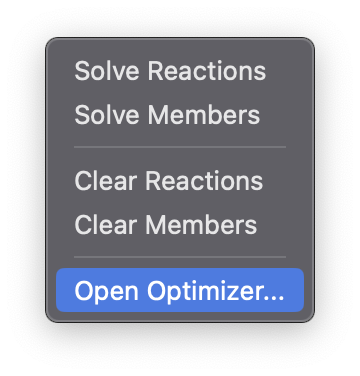
Action: Navigate to Solve>Open Optimizer.
Click on the Settings tab.
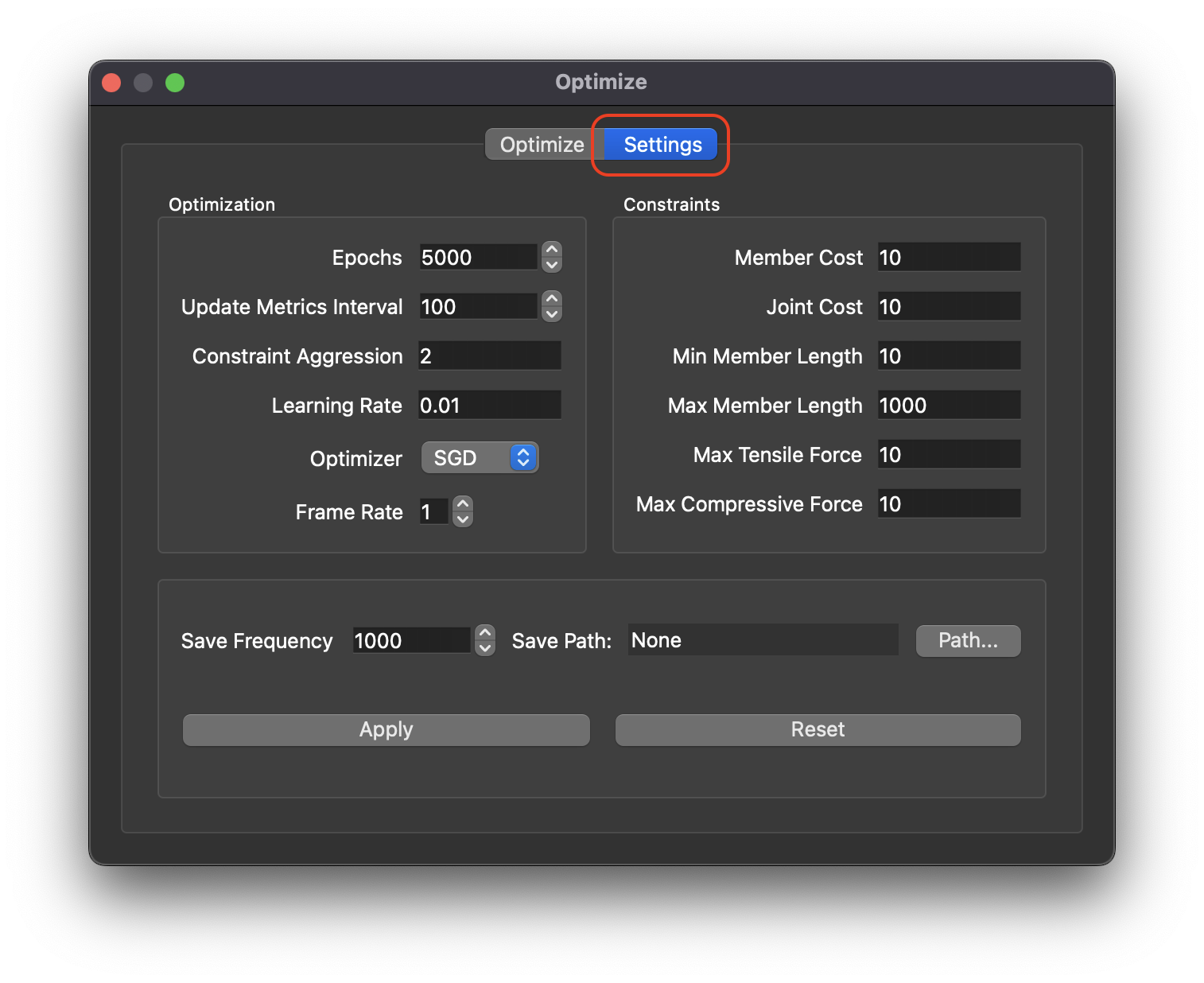
Constraints: Constraint limit the optimization if a certian critiria is met. A truss will optimize as to not break any constraints.
Member Cost: the cost per unit (e.g. m, km, cm, etc.) of a member in dollars or any other unit.
Joint Cost: the cost the cost of a single joint.
Min Member Length: the minimum length of a member in chosen unit.
Max Member Length: the maximum length of a member in chosen unit.
Max Tensile Force: the maximum tensile force a single member can withstand in the chosen force unit (e.g. N, lb, etc.).
Max Compresive Force: the maximum compresive force a single member can withstand in the chosen force unit.
Optimization: Setting to tweak how a truss optimizes.
Epochs: how many training iterations to run.
Update Metric Interval: how often to update truss visual when training. This can have a measurable impact on performance if it is set too low. Recomended is 50 and up.
Constraint Aggression: defines how stricly a truss adhears to the outlined constraints. For example with a high constraint aggression (typically greater than 5) the algorithm will heavily priotize rearranging the joints as to not break any of the constraints before optimizing the cost of the truss. However, with a low constraint aggression (typically less than 5) the algorthim will prioritize the cost of the truss more than the constraints.
Max Member Length: the maximum length of a member in chosen unit.
Max Tensile Force: the maximum tensile force a single member can withstand in the chosen force unit (e.g. N, lb, etc.).
Max Compresive Force: the maximum compresive force a single member can withstand in the chosen force unit.